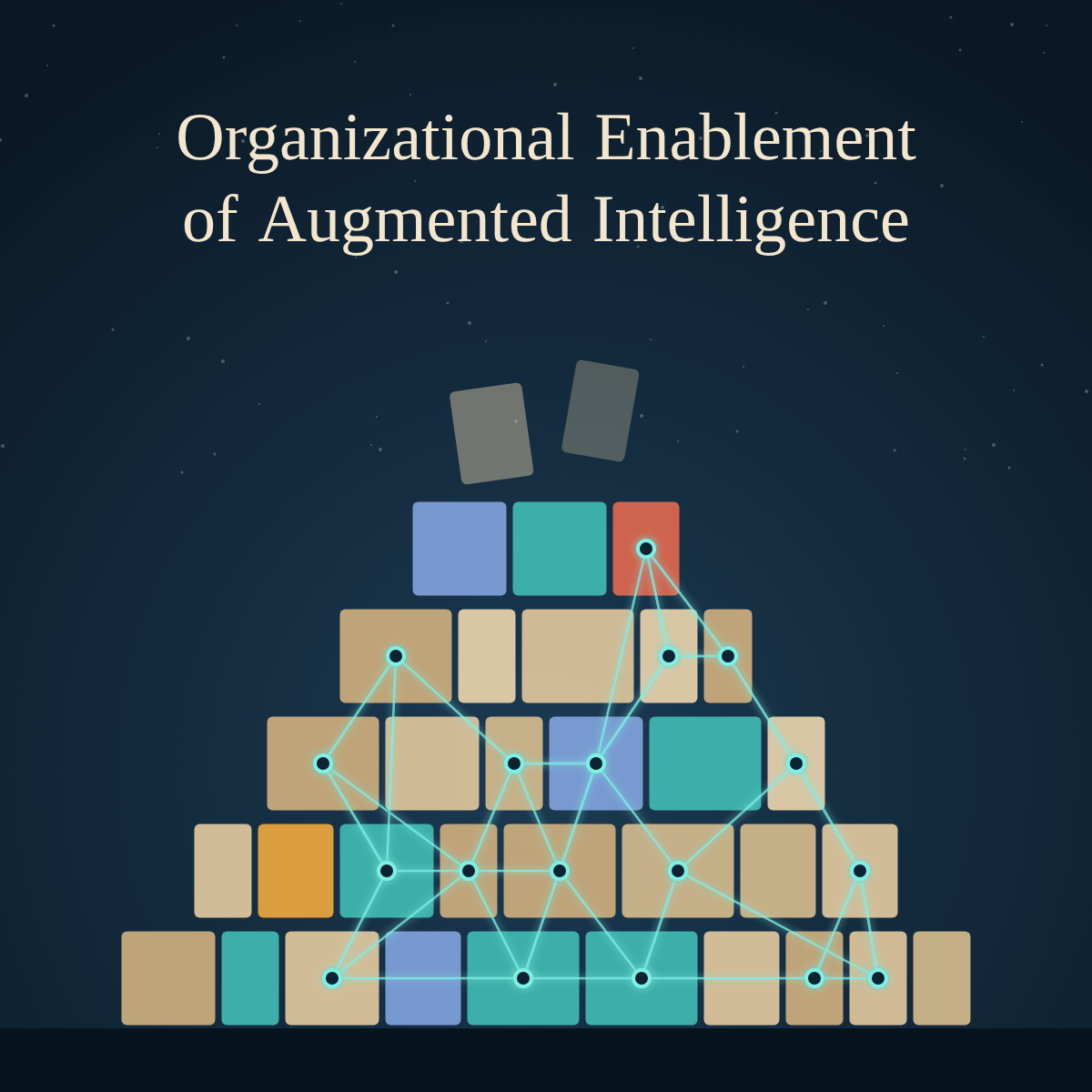
Rebuilding Babel: Why Generative AI Needs a Network, Nota Pyramid
Remember the Tower of Babel? People built higher and higher, reaching for the heavens until their God took note of their hubris and confounded their common language. No longer able to understand each other, they stopped work and scattered.
I’ve been thinking about that story in the context of generative AI. Not because of the fear that surrounds the technology, or the hubris of the tech world as they pursue it (though there is plenty of it), but because of what Babel describes: a group of capable people who lost the ability to connect what each of them knew.
That is a fair description of most organizations today.
A Collection of Pieces, No Picture
Often, despite our best efforts, we still work in silos. Geologists, engineers, commercial teams and executives each reach their own conclusions, but the cause-and-effect links between those conclusions are often lost. Some connections only become visible after years of experience. Others never become visible at all.
Subsurface exploration makes this painfully clear. We rarely know the answer in advance. We build models, make assumptions and test them. Even when a well succeeds, we often can’t say which part of the model actually worked. The unknowns never fully disappear.
People add to the problem. We hide information we don’t fully understand, or keep our stories to ourselves. Organizations keep insights inside specialist groups because it’s easier to manage that way. The result is that no one sees the full picture. We have a pile of colors, shapes and fragments.
It’s like a jigsaw puzzle without the picture on the box. Without that guide, you don’t know how the pieces fit. Without the edges, you can’t even get started.
The Myth of the Ultimate Brain
Throughout history we’ve organized ourselves around a single figure at the top: a king, a president, a CEO. The pyramid assumes the best brain sits at the summit, holding every thread and making the call.
Let’s be honest: that’s rarely the case. Even a brilliant leader can’t keep every thread in mind at once. The result is ambiguous decisions, misread cause and effect, and connections drawn between the wrong facts.
There is a better structure: a network. Different aspects of a problem are explored by the people who specialize in them. Someone still leads and shapes the conversation, so it isn’t random, but insight no longer depends on a single mind. Bringing every voice into the discussion is slower and sometimes painful. It is also the only way to see the whole picture.
What Generative AI Is Actually Good For
This is where generative AI earns its place. The human brain can’t hold all the threads at once. AI can.
It can keep many lines of evidence together and surface the different flavors, signals and perspectives a decision-maker should weigh. Think of it as the best assistant you’ve ever had: one that remembers every appointment, knows where every file lives, and can lead you toward a key you have lost.
But the answer is still yours. You must understand how and why the pieces fit together. AI empowers judgment; it does not replace it.
The Danger of AI in the Corner
There is one condition: AI has to bring people together. A single AI tool running in a corner of the organization, used by one team in isolation, will create more problems than it solves. It just builds a faster, smarter silo.
Used well, generative AI reverses Babel. It translates between the specialist languages of an organization and reconnects the knowledge that structure has kept apart.
The Babel story offers a second warning, and we shouldn’t overlook it. Hubris. The builders weren’t stopped merely because they lost a common language. God stopped them because of what they were trying to do: build high enough to stand beside God. Their ambition outran their wisdom.
Generative AI invites the same temptation. When a tool can summarize a decade of reports in seconds or produce a confident answer to almost any question, it is easy to believe we have finally conquered uncertainty. We haven’t.
In exploration, we know this lesson well. A model that fits the data beautifully can still be wrong. A fluent, well-structured AI answer can be wrong in exactly the same way, only faster and more persuasively. The danger isn’t that AI makes mistakes; people do too. The danger is that we stop questioning, hand over our judgment, and scale our errors across an entire organization before anyone notices.
The unknowns haven’t gone away just because the answers sound more certain. That calls for humility:
- Treat AI output as a hypothesis to test, not a verdict to accept.
- Keep people accountable for decisions, and expect them to explain why the pieces fit.
- Adopt AI in measured steps, learning what it does well and where it fails, before betting the business on it.
- Respect what experience teaches, especially the hard lessons that no dataset fully captures.
Turning the Pyramid Inside Out
The real shift is this: intelligence does not live at the top of the pyramid. It lives throughout it, with Augmented Intelligence facilitating exchanges among members of different disciplinary teams and yielding insights through iterative experience across disciplines and roles. The answer to the question we all seek: “What does it mean?” changes with each new data point, methodology update, scale, data coverage, and resolution.
Generative AI gives us the chance to make that network visible and usable. Whether we take it depends on whether we treat AI as a shared instrument for collective thinking or as one more tool in the corner.
The tower can be built. This time, we just need to keep speaking the same language and make an effort to hear each other. No ear muffs.
Ambition built the tower. Humility is what would have kept it standing.
